
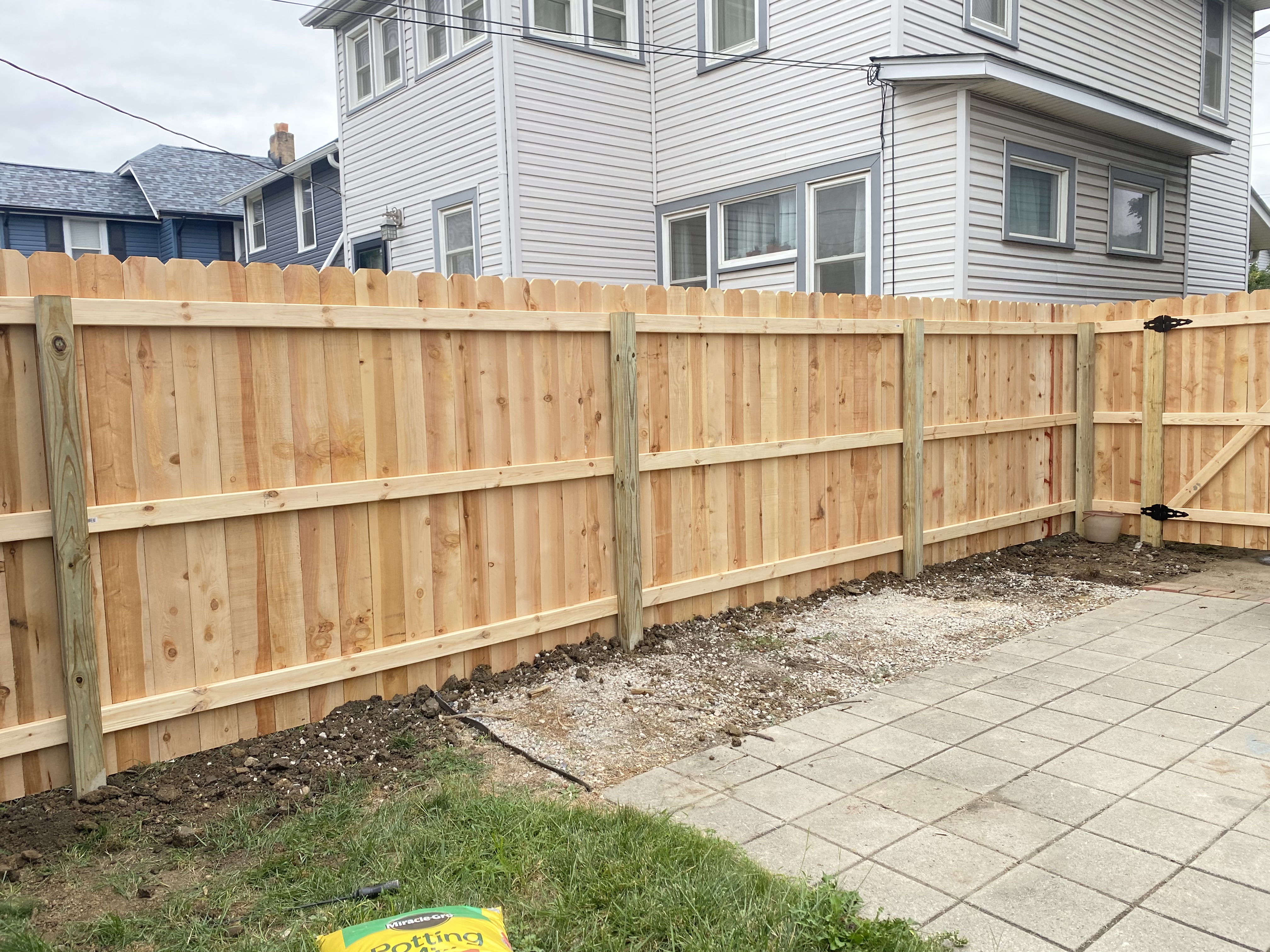
At Fence Company of Columbus, we install both materials all over central Ohio. Here is a straight comparison that should help you decide which one fits your project.
Cedar is a naturally rot resistant softwood, most often western red cedar in the Midwest. The wood contains natural oils that make it unfriendly to fungi and insects, so it does not need any chemical treatment to hold up outdoors. It ships as raw lumber and installs with no surface treatment of any kind.
Pressure treated pine is southern yellow pine that has been infused with a copper based preservative under pressure. The treatment penetrates deep into the grain and protects the wood against rot, insects, and ground contact for decades. The slightly green tint on a freshly installed pressure treated fence is the treatment chemistry, not paint or stain. It fades to a natural tan within a few months as the wood dries out.
Both are proven options for an Ohio wood fence. They simply get you to a similar finish line through different paths.
Pressure treated pine is meaningfully less expensive than cedar, often by 25 to 40 percent on a comparable run depending on lumber market conditions. For homeowners watching the budget, pressure treated is the standard pick on most residential privacy projects in central Ohio.
Cedar costs more because the lumber itself is more expensive and most of the supply ships in from the Pacific Northwest. The premium typically lands somewhere in the few hundred to few thousand dollar range on a typical backyard run, depending on linear footage.
Cedar starts as a warm honey blonde with red undertones running through the grain. It looks finished from day one, even without stain or sealer.
Pressure treated pine starts with that slightly green tint that throws some homeowners off the first time they see it. Worth saying again. The green is the preservative chemistry. It is supposed to be there. Within a few months the green fades to a natural tan, and within a year or two the wood weathers further to a soft silver gray.
This is where the two woods diverge.
Both can be sealed or stained to hold a warmer wood tone. Both look completely fine left to weather naturally. The choice is purely aesthetic.
Cedar and pressure treated are similar on the maintenance front. Neither requires regular treatment to last. Both benefit from a wash and reseal every three to five years if the homeowner wants to preserve a warmer wood tone year round.
If you let either material weather naturally, the actual upkeep is minimal. Spot replace damaged boards as needed. Keep an eye on posts at the ground line. That is most of the lifecycle work either material will ask of you.
Properly installed, both materials will hold up for 20 to 30 years in central Ohio. Some installs go longer. Lifespan is much more about installation quality, post depth, and ground line drainage than it is about the wood species. We have torn out 35 year old pressure treated posts that were still solid and seen 15 year old cedar fences fail because the posts were set too shallow.
A simple framework for picking between the two:
Both are excellent choices for an Ohio yard. Neither is wrong. We walk through the comparison at every wood fence estimate so the homeowner picks the material that fits the budget and the look they actually want.
Whether you are leaning cedar or pressure treated, Fence Company of Columbus can walk you through the trade offs in person and put together a quote that fits your yard. We are family owned, locally based in Powell, and proudly serve Powell, Dublin, Westerville, Worthington, Hilliard, Upper Arlington, Delaware, and the surrounding communities.
👉 Call us today at 614-412-2399 to schedule a free estimate.


Business License # HIC-L01324

