
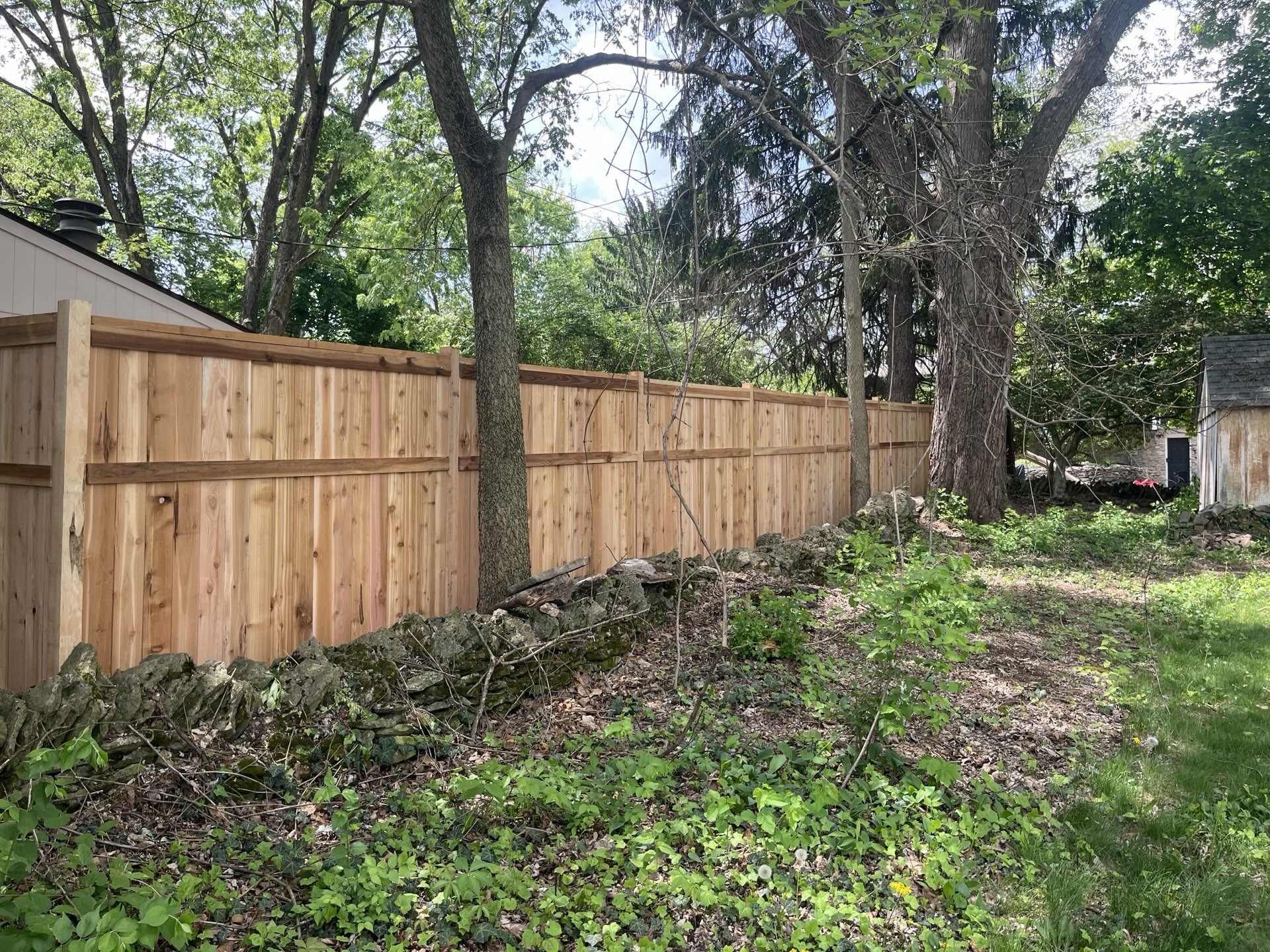
When fencing a yard with existing trees, keep the fence 3 to 5 feet away from any mature tree trunk to protect the root zone. Avoid running the fence line through the tree's drip line (the circle under the outer branches), and never trench for the fence within that zone. If the fence must pass close to a tree, use fewer posts and longer panels to reduce root disturbance.
Mature trees are one of the best features a yard can have, and one of the most common obstacles at a fence install. At Fence Company of Columbus, we plan fence lines around trees on almost every acreage or wooded-lot install. Here is how to protect the trees while still getting the fence line you want.
A mature tree has a root system that extends roughly as far horizontally as the branches extend upward. Most of the fine feeder roots (the roots that actually absorb water and nutrients) live in the top 12 to 18 inches of soil, spread across a wide area. Digging post holes through that root zone damages roots directly and disrupts the soil ecology the tree depends on.
A fence installed too close to a tree can also physically damage the trunk as the tree grows, and the tree can eventually push posts out of plumb as roots expand.
Sometimes the fence line has to pass close to a tree. A few adjustments make that work:
Custom panel widths let a fence dodge around a trunk without breaking the visual line. A standard 8 foot panel can be trimmed to 6 or 4 feet at a tree pass. The rails still tie in cleanly to the adjacent posts.
Overhead branch clearance also matters. Panels that press against low limbs cause damage to both the tree and the fence over time. Trimming branches back to give the fence 12 to 18 inches of clearance protects both.
Solid privacy fences (wood dog ear, vinyl privacy) are the hardest style to blend with mature trees because they wall off the visual softness that made the wooded yard attractive in the first place. If privacy is required, consider whether a lower height (5 feet instead of 6) reduces the visual weight against the trees.
Branches overhanging a fence line are a maintenance issue, not an install issue. Deadwood eventually falls. Live branches shed leaves, seeds, and sometimes sap onto the top of the fence. A few practical points:
Trim back to 12 to 18 inches of clearance above the top of the fence before install. Retrim as needed every few years. For fences under mature oak or maple canopies, plan on more frequent cleaning to keep debris from staining the top edges.
Root barriers (vertical plastic or geotextile sheets buried between the tree and the fence line) can prevent future root damage to fence posts. They are worth considering when the fence must pass within a few feet of a mature tree with aggressive roots (silver maple, willow, black locust). They are overkill for slower-rooted species like oak or beech.
How close can a fence be to a tree?
Three feet from a mature trunk is a practical minimum. Five feet is safer for the tree and the fence.
Should I remove a tree before fencing?
Only if the tree is already declining or the fence line cannot practically work around it. Mature landscape trees are worth more than the additional fence complexity in almost every case.
Will roots eventually damage my fence posts?
Roots from aggressive species can push posts out of plumb over 10 to 20 years. Slower-rooted trees rarely cause problems. Root barriers help when needed.
Can trees be inside a fenced yard?
Yes, and this is the most common configuration. Trees inside the yard are protected from mowing damage, gain security, and rarely conflict with the fence itself because they are set back from the fence line.
At Fence Company of Columbus, we plan fence lines around mature trees rather than through them, protecting the trees and the fence with post placement, panel adjustments, and material choices that fit the site.
👉 Call us, email us, or fill out the form on the home page to receive a free quote. We serve Powell, Dublin, Sunbury, Worthington, Hilliard, Upper Arlington, and Delaware.
Written by the team at Fence Company of Columbus, updated July 2026.


Business License # HIC-L01324

