
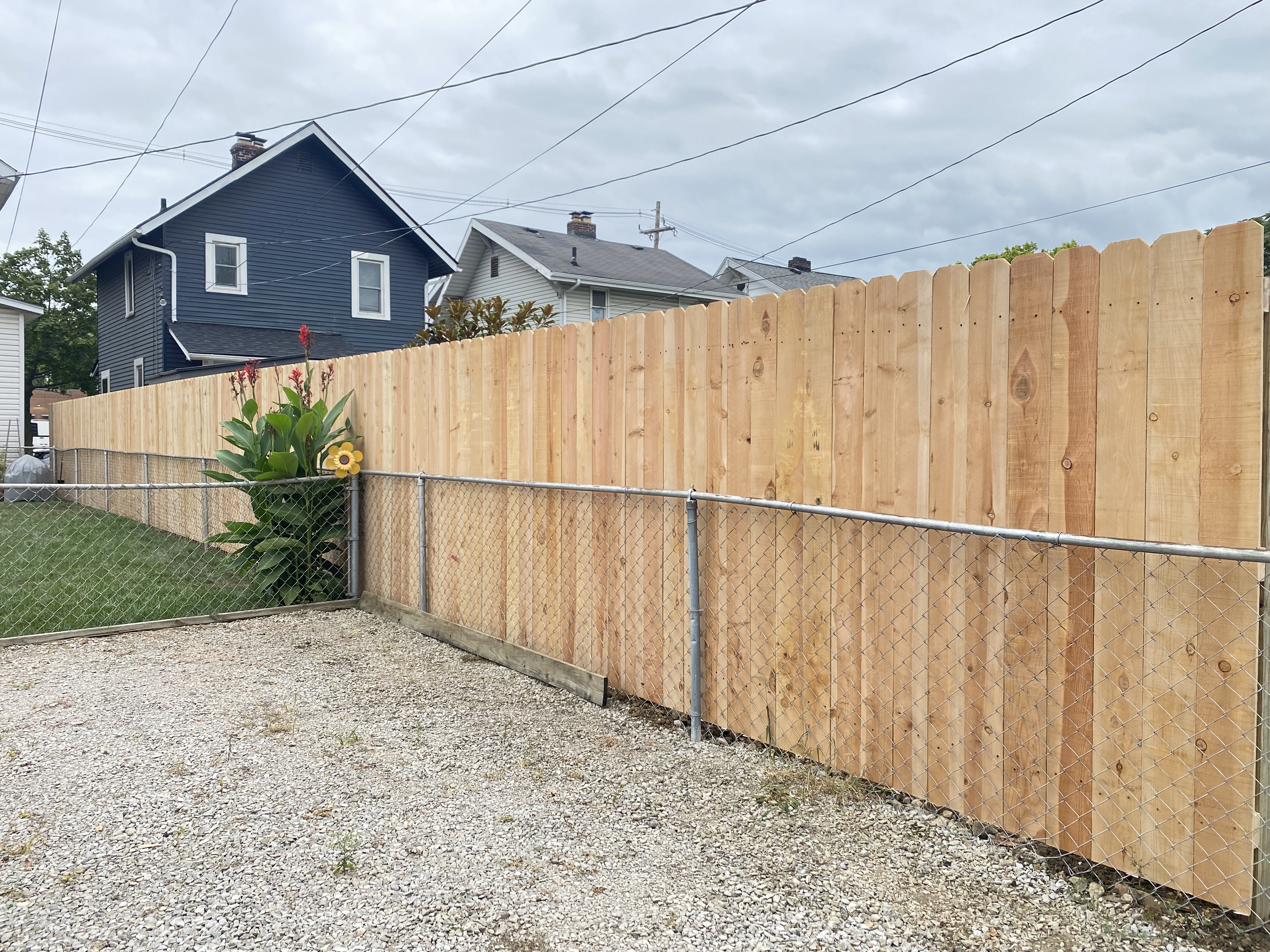
The finished smooth side of a wood fence traditionally faces the neighbor, and the framing rails and posts face your own yard. This practice is called the good neighbor approach, and it is the standard for property line fences across Ohio. The exception is a fence built entirely on your side of a shared line, where you get to choose which side faces which way.
Every wood fence estimate we do at Fence Company of Columbus involves the same question, usually asked halfway through the property walkaround. Which side of the fence faces my neighbor? The answer is almost always the same. Smooth side faces the neighbor, framing side faces the homeowner. Here is why that convention exists and when it applies to your project.
A standard wood privacy fence has two visually different sides. The smooth side shows the finished face of the vertical boards. The framing side shows the horizontal 2 by 4 rails that hold the boards in place, along with the posts.
The good neighbor approach faces the smooth side outward, toward the neighbor. The framing rails face inward, toward the homeowner who paid for the fence. The idea is that you give the neighbor the more attractive view, since you are the one who initiated the project.
A few reasons why this became the norm in Ohio and most of the country:
If the whole conversation about which side faces which way makes you uncomfortable, there are two fence styles that skip it entirely. Shadowbox and board on board fences are built so that both sides look finished. Neither side is the framing side. Both neighbors see a complete fence face.
The tradeoff is a slightly higher cost per linear foot and less true privacy at close range, but the visual result is symmetrical from both yards. For homeowners in shared-line situations who want to avoid the neighbor conversation, this is often the answer.
If your fence sits entirely on your side of the property line rather than on the shared line itself, you have full discretion. The neighbor has no legal say in which way the fence faces. In that case, most homeowners still put the framing side facing their own yard for maintenance access, but some flip it for aesthetic reasons.
If you are unsure whether the fence is on the shared line or on your side of it, a boundary survey clarifies this. We recommend one before any property line fence install.
The best time to have the good neighbor side conversation is before the estimate is signed, not after the posts are set. A few practical suggestions:
Is the good neighbor side required by law in Ohio?
Not at the state level, but many central Ohio municipalities and HOAs require it. Local fence code varies by city, so check with your building department before install.
What if my neighbor and I split the cost of the fence?
Even with cost sharing, the fence has one framing side and one smooth side. A common approach is to alternate the framing side by section, so each yard gets an equal amount of finished view, or to install a shadowbox style where both sides look finished.
Does the good neighbor rule apply to vinyl fences?
Vinyl privacy panels typically have a finished face on both sides because the boards are tongue and groove construction inside a frame. The good neighbor question does not really apply to vinyl for that reason.
What about picket fences?
Wood picket fences still have a framing side (the horizontal rails behind the pickets). The good neighbor rule applies the same way. Smooth pickets face outward, rails face inward.
At Fence Company of Columbus, we install wood privacy fences with the good neighbor side handled correctly the first time, and we walk you through the property line conversation before the estimate is even signed.
👉 Call us, email us, or fill out the form on the home page to receive a free quote. We serve Powell, Dublin, Westerville, Worthington, Hilliard, Upper Arlington, Sunbury, and Delaware.
Written by the team at Fence Company of Columbus, updated July 2026.


Business License # HIC-L01324

