
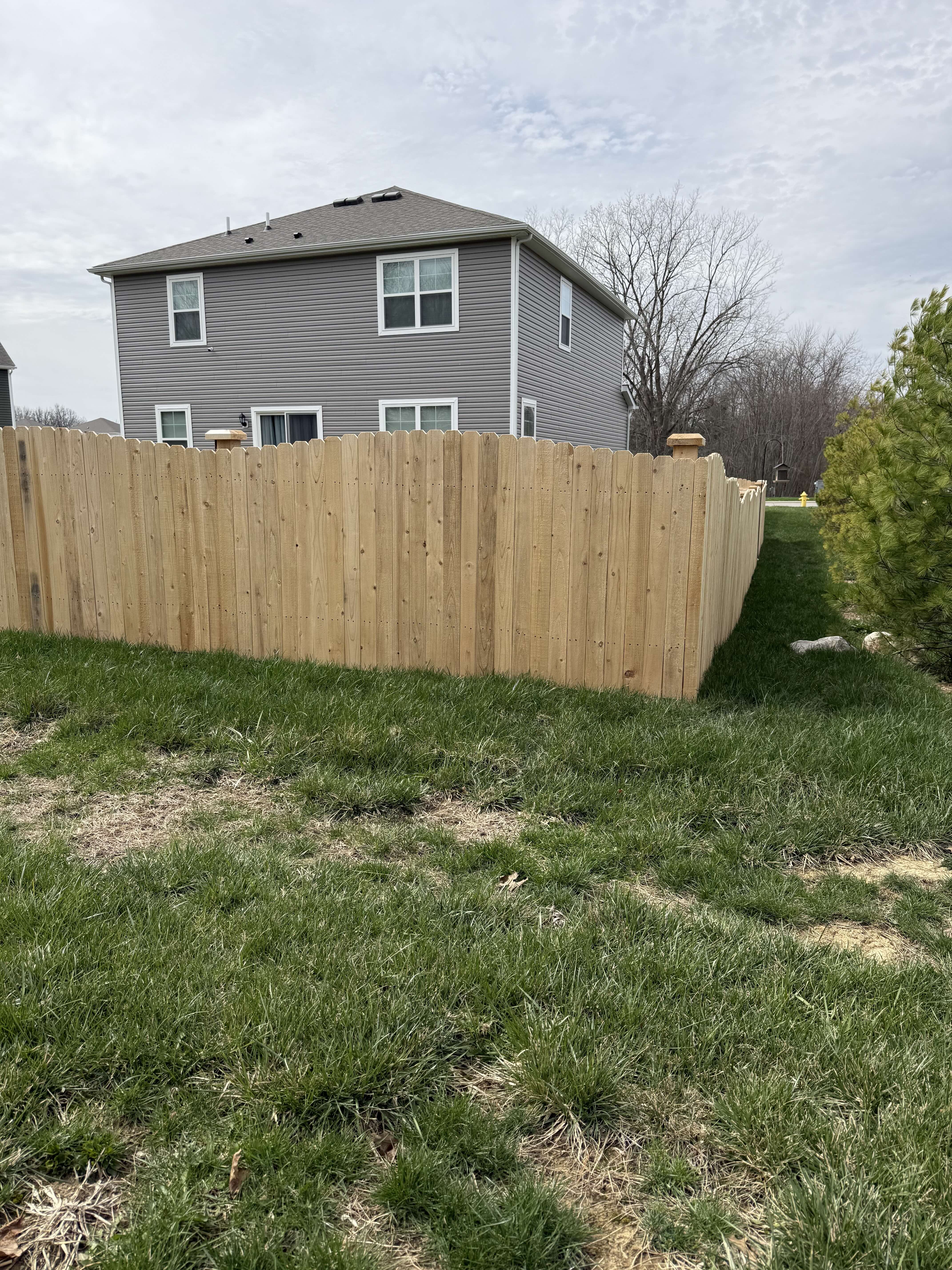
Fences on sloped ground are installed in one of two ways: racked (the panel tilts to follow the ground line) or stepped (each panel is level and the height steps down at each post). Racked is smoother and works up to about 15 degrees of slope. Stepped works for steeper grades and long uneven runs. Which method to use depends on the fence style, the slope severity, and how uniform you want the fence line to look.
Ohio yards rarely sit perfectly flat. Between drainage grading, natural terrain, and landscape design, most fence lines have to handle at least some slope. At Fence Company of Columbus, every wood, vinyl, and aluminum fence we install includes a slope-handling decision. Here is how the two main methods work and when to use each.
Every fence panel has two options when the ground slopes:
**Racked** means the panel itself tilts to follow the ground. The top of the panel matches the ground slope. The vertical boards or pickets stay perpendicular to gravity, but the rails run at an angle. From a distance, the fence looks like a smooth line following the terrain.
**Stepped** means each panel stays level. When the ground drops, the next panel starts lower than the previous one, creating a visible step at each post. From a distance, the fence looks like a staircase running along the terrain.
Racked panels rely on the fence style being flexible enough to tilt without visible distortion. Standard wood picket, wood privacy with vertical boards, and split rail all rack well because the vertical boards stay vertical regardless of the panel angle.
Racked works cleanly up to about 15 degrees of slope. Above that, the rack becomes visually awkward and the panels start to look like they are falling over. Racked installs also require slightly custom rail cuts on each panel to maintain the tilt, which increases labor time.
Stepped installs use standard panels. Each panel sits level. The grade change happens between panels, with the base of each new panel starting lower than the top of the previous one.
Stepped works for any slope but leaves gaps under the fence at each step, where the ground drops away from the panel base. On mild slopes, the gaps are small enough to ignore. On steep slopes, they can be 6 to 12 inches at the low corner of each panel, which is a visual detail and a pet containment issue.
The step gaps can be filled with lattice, stone, retained soil, or a decorative kickboard, all of which add cost and complexity.
Some projects use both methods on the same fence. Racked on the milder sections, stepped where the grade change is significant. A good contractor plans the transitions so they read as intentional rather than patched together.
Slope adds cost in a few different ways:
Stepped installs create a gap between the fence base and the ground at the low corner of each panel. On a mild slope, the gap is a few inches. On a steep slope, it can be a foot or more. This creates two issues:
Which method is more common in Ohio?
Racked for wood fences, stepped for vinyl. Ohio yards generally have mild slopes that racked wood handles well. Vinyl's construction pushes those installs toward stepped by default.
Can vinyl fences be racked?
Only in specific rackable panel systems, which are less common and more expensive than standard vinyl. Most vinyl installs on slopes use stepped installation.
What is the maximum slope for a racked install?
About 15 degrees. Beyond that, the visual gets awkward and stepped is a better choice.
Does a slope require special post depths?
The frost line depth (30 to 36 inches in Ohio) still applies. Posts on sloped ground are measured from the downhill side to maintain proper footing depth.
At Fence Company of Columbus, we walk sloped properties before quoting and recommend racked versus stepped based on the specific terrain, fence style, and homeowner preferences, so the finished fence looks intentional rather than patched together.
👉 Call us, email us, or fill out the form on the home page to receive a free quote. We serve Powell, Dublin, Westerville, Worthington, Hilliard, Upper Arlington, and Delaware.
Written by the team at Fence Company of Columbus, updated July 2026.


Business License # HIC-L01324

