
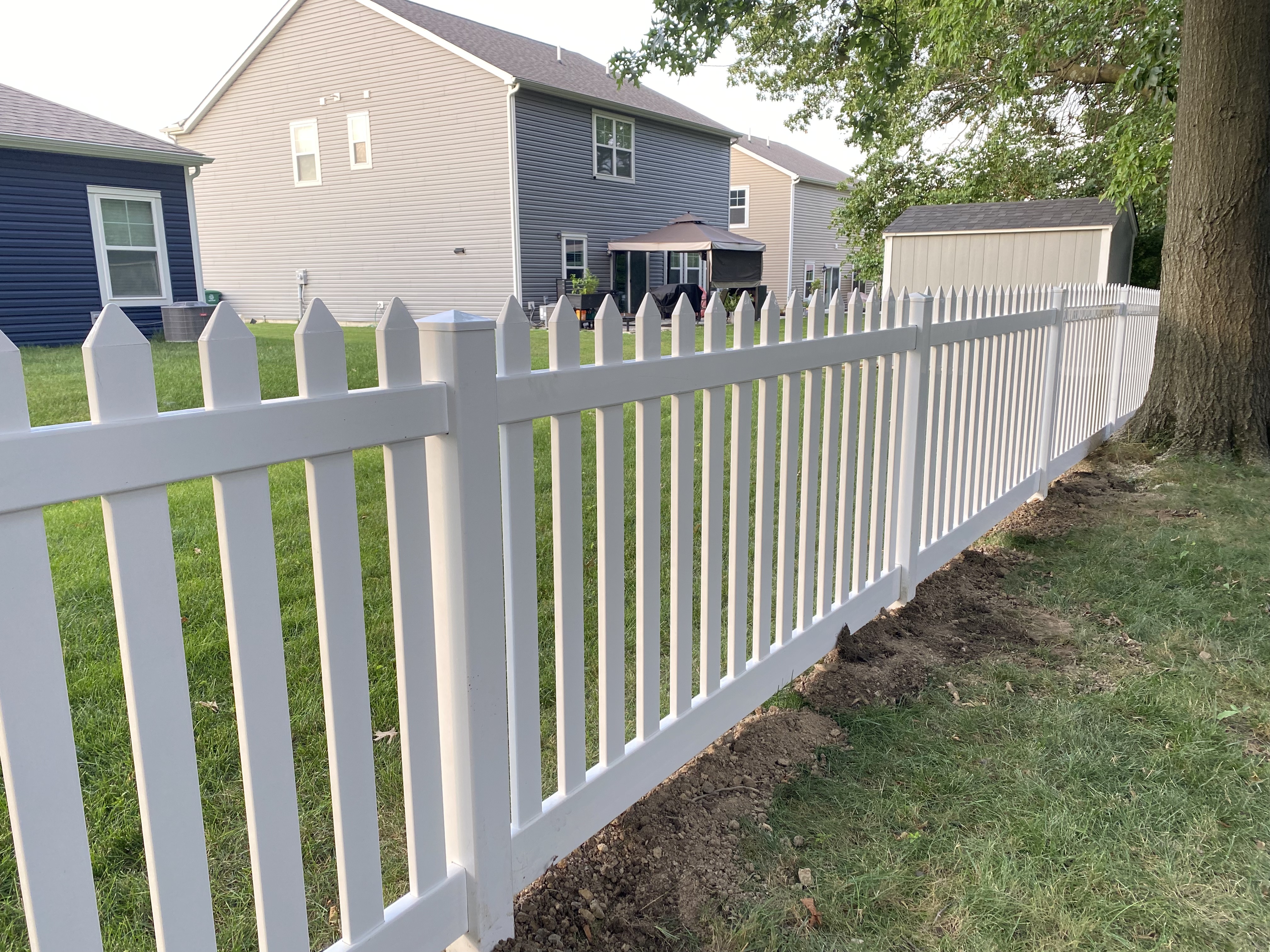
Fence posts in Ohio need to be set 30 to 36 inches deep, past the frost line, on a concrete footing. Shallower posts will heave during the first winter as the ground freezes and thaws, then lean permanently within a few seasons. Proper post depth is the single most important factor in whether a fence lasts 5 years or 30.
At Fence Company of Columbus, the most common cause of fence failure we see is not board damage or hardware wear. It is posts set too shallow. Ohio's freeze thaw cycles will destroy a shallow post in a way that is essentially unfixable without full replacement. Here is how deep posts need to go and why it matters.
The frost line in central Ohio is officially 32 inches, though it varies slightly by county. That is the depth at which the ground freezes during a typical winter. Water in the soil above the frost line freezes, expands, and pushes upward. Water below the frost line stays liquid and stable.
A post set above the frost line gets pushed upward every time the ground freezes. Over one winter, the movement is measurable. Over five winters, the post is visibly high and starting to lean. Over ten, the fence is failing.
A post buried 30 to 36 inches deep has its base below the frost line, in stable unfrozen soil. The freezing action above cannot push it up because the concrete footing sits in stable ground. Over the same 10 year window, a properly set post stays exactly where it was installed on day one.
Some contractors set posts shallower to save time. A 24 inch post hole is faster to dig and requires less concrete. It is also almost guaranteed to fail in Ohio within a decade. The savings on install day cost the homeowner years of fence life.
A proper post footing is not just concrete poured around a post. It is a specific shape and depth that transfers wind load into the soil and prevents water from pooling at the base.
Fences with shallow posts fail in a predictable sequence. In year one, everything looks fine. In year two, the fence line starts to look slightly uneven when viewed from the end. In year three, individual posts begin to lean noticeably. By year five, gates stop closing, boards start pulling away from rails, and multiple posts are visibly out of plumb.
At that point, the only real fix is to reset every post. Reset costs about half of full replacement, and the boards and rails on a 5 year old fence usually have another 15 to 20 years of life in them. The economics rarely work out in favor of the reset. Most homeowners replace instead.
Is the frost line the same across all of Ohio?
It varies slightly. Central Ohio's frost line is officially 32 inches. Northern Ohio is deeper (32 to 36 inches typical). Southern Ohio is shallower (28 to 32 inches). Setting posts 30 to 36 inches deep works safely across the state.
Can shallow posts be fixed without full replacement?
Individual shallow posts can be reset. Widespread shallow post problems across the whole fence are usually not economically worth fixing. Full replacement typically wins on cost per year of remaining life.
Do vinyl fence posts need to be as deep?
Yes. Post depth is about ground behavior, not fence material. Vinyl posts set at 24 inches heave the same as wood posts. All fence types in Ohio need posts set 30 to 36 inches deep on concrete footings.
How wide should the post hole be?
Roughly 3 times the post width. A 4 by 4 wood post needs a 12 inch wide hole. A 6 by 6 corner or gate post needs an 18 inch wide hole. The extra concrete provides the load transfer that keeps the post plumb over decades.
At Fence Company of Columbus, we set posts to 30 to 36 inches on concrete footings for every fence we install, because it is the single detail that determines whether a fence lasts 5 years or 30.
👉 Call us, email us, or fill out the form on the home page to receive a free quote. We serve Powell, Dublin, Westerville, Worthington, Hilliard, Upper Arlington, and Delaware.
Written by the team at Fence Company of Columbus, updated July 2026.


Business License # HIC-L01324

