
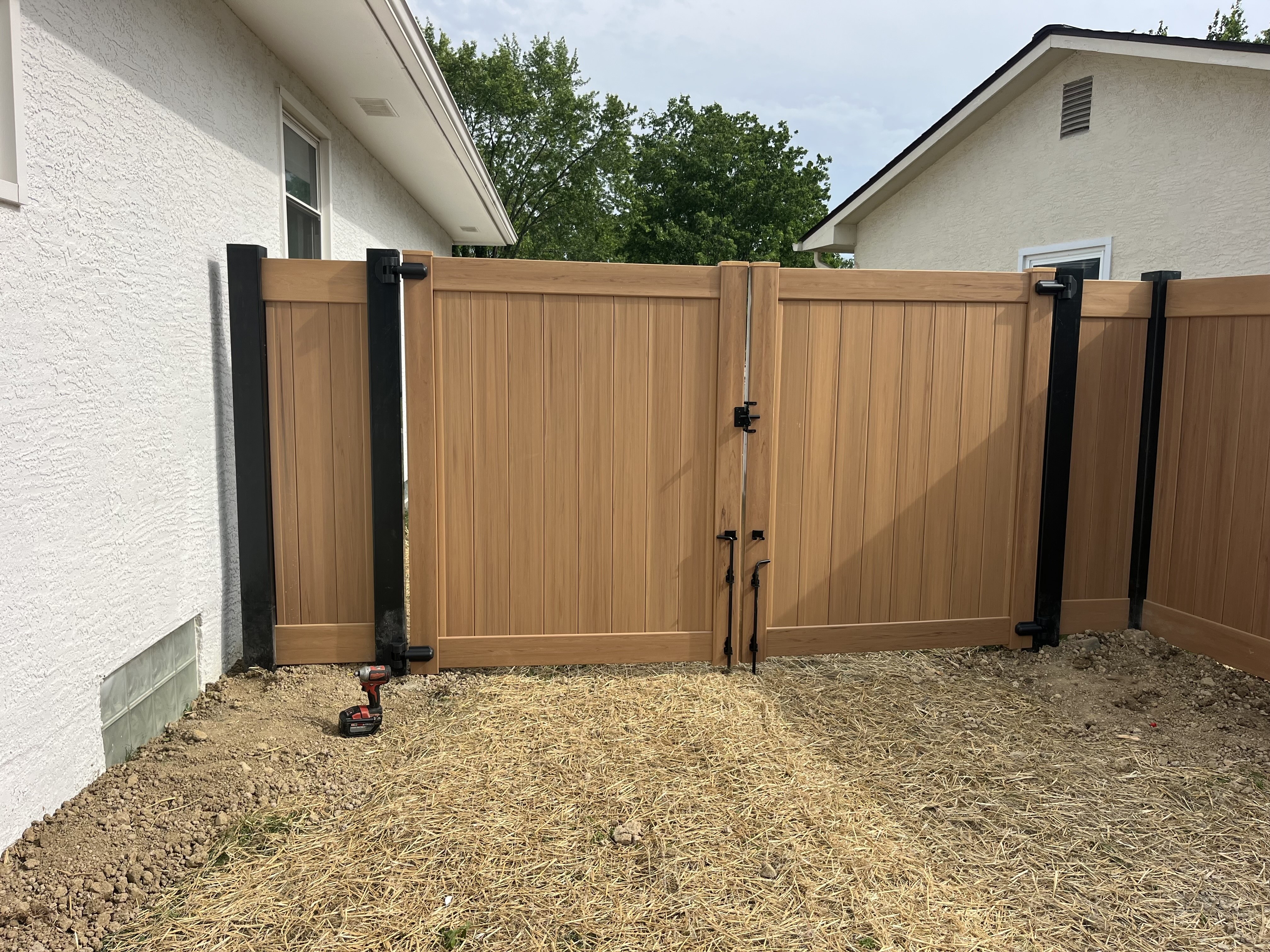
Use a single swing gate when the opening is under 5 feet wide (pedestrian access, small yard entries). Use a double swing gate when the opening is 5 to 12 feet wide (driveways, lawn equipment access, wide side yards). Single swing gates cost less and have simpler hardware. Double swing gates handle wider openings without one long heavy panel that would sag and require industrial-grade hardware.
At Fence Company of Columbus, we install pedestrian and utility gates on almost every fence project. The single vs double decision comes down to opening width and what has to pass through it. Here is how to pick.
A single swing gate is one panel on hinges on one side of the opening, latching on the other. It is the standard for pedestrian access and side yard entries. Practical width range: 3 to 5 feet.
Advantages: fewer moving parts, simpler hardware, lower cost, quick to open with one hand. Disadvantages: gets heavy fast as width increases, requires stronger hinges on wider single-swing installs, needs unobstructed swing radius on one side.
A double swing gate is two panels, each on hinges at opposite sides of the opening, that meet in the middle. Common for driveways, lawn equipment paths, and any wide access opening. Practical width range: 5 to 12 feet.
Advantages: handles wide openings without a single heavy panel, each panel is half the weight of an equivalent single gate, aesthetically balanced from either side. Disadvantages: more hardware to install and maintain, requires a center drop rod or cane bolt to hold the inactive leaf, more complex latching.
Single swing gates need two heavy-duty hinges and a latch. That is essentially the whole hardware list. Double swing gates need four hinges (two per leaf), two latches or a coordinated center latch, and a drop rod or cane bolt to hold one leaf stationary while the other is used as the primary access.
Weight ratings on hinges matter more than most homeowners realize. A 5 foot wide wood or aluminum gate is heavier than most standard residential hinges are rated for. Confirm the hinge is rated for the actual gate weight, not just the width.
Wood single gates start to sag noticeably around 4 feet wide unless they are aggressively cross-braced with an X brace. At 5 feet wide, sag is essentially inevitable over time regardless of bracing. Wood single gates over 5 feet wide are best avoided. Split into a double if the opening requires that width.
Aluminum and vinyl single gates handle wider spans better because they are lighter overall, but even those have practical limits around 6 to 8 feet before double gates become the smarter choice.
For very wide driveway openings (12+ feet), sliding gates are an alternative to double swing. Sliding gates need track along the ground or an overhead cantilever rail. Advantages: no swing radius required, works even when snow or gravel blocks a swing arc. Disadvantages: more complex installation, more expensive hardware, motorized operation typically required for practical use.
How wide can a single swing gate be?
Up to about 5 feet practically. Beyond that, weight and sag issues make double swing the better choice.
Can I add a double gate to an existing fence?
Yes. A double swing gate can replace a single swing or a fixed section of fence. The main considerations are post strength (gate posts carry more load than standard posts) and swing clearance.
Do double gates need extra bracing?
Each leaf of a double gate needs the same X bracing that a single gate requires. Neither leaf should sag under its own weight.
Which is safer for kids?
Single swing gates with self-closing hinges and self-latching hardware are the standard for child safety, including around pools. Double gates can also be made child-safe but require careful hardware selection.
At Fence Company of Columbus, we help homeowners size gates to the actual opening and use case, so the gate you get holds up over years of daily use rather than sagging within a season.
👉 Call us, email us, or fill out the form on the home page to receive a free quote. We serve Powell, Sunbury, Westerville, Worthington, Hilliard, Upper Arlington, and Delaware.
Written by the team at Fence Company of Columbus, updated July 2026.


Business License # HIC-L01324

